Germany
Saxony-Anhalt: The AfD needs the BSW, but does not trust it
By Lars Frohmüller
Published September 29, 2026
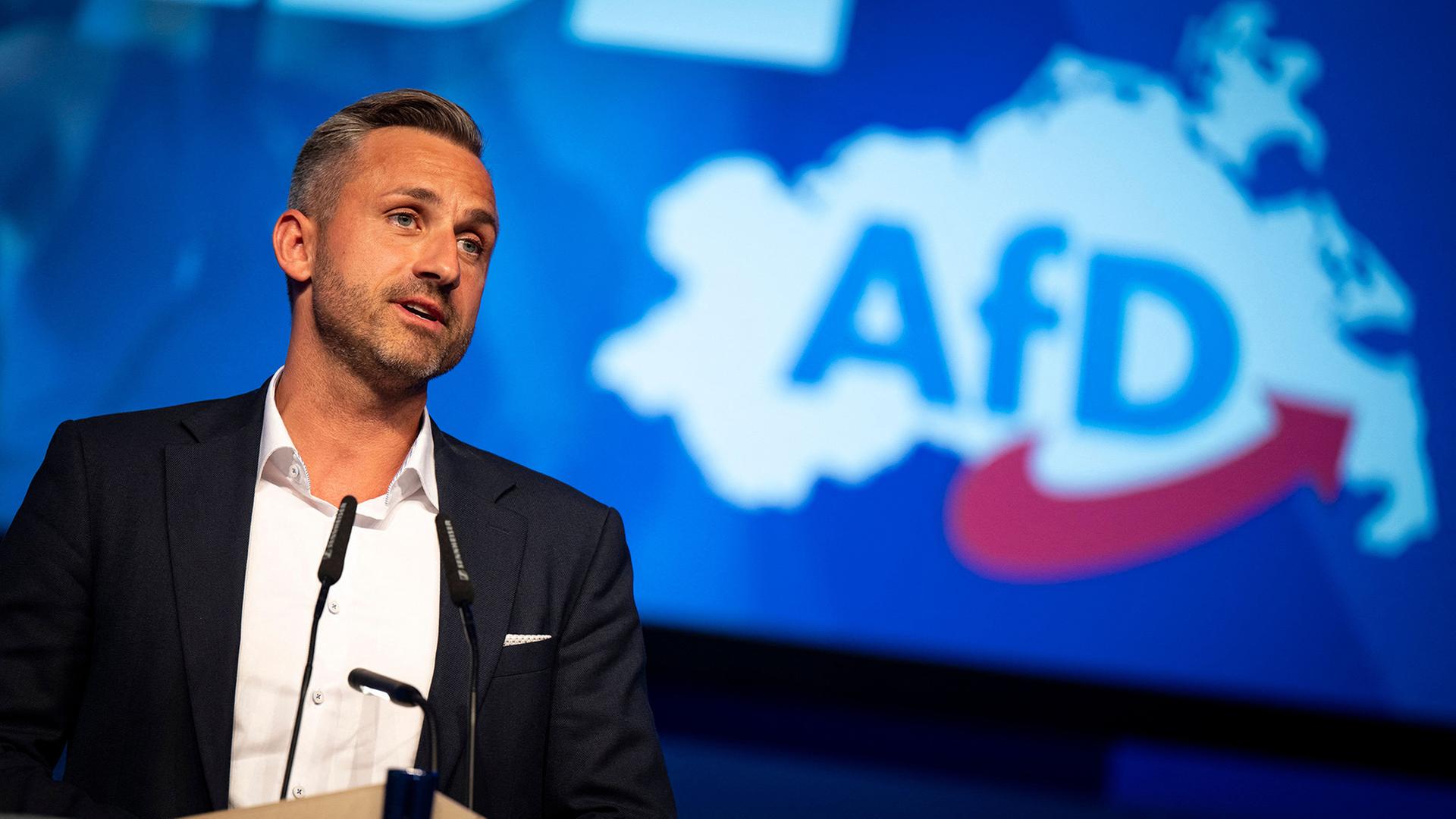
Three weeks after the election, the AfD is seeking a majority in Magdeburg. The BSW can be wooed, but Ulrich Siegmund does not want to vote. And the SPD is trying a final counter-proposal that will not suffice.
Three weeks after the election, the AfD is seeking a majority in Magdeburg. The BSW can be wooed, but Ulrich Siegmund does not want to vote. And the SPD is trying a final counter-proposal that will not suffice. By Lars Frohmüller, MDR The SPD invited the Left, Greens and BSW to Magdeburg for talks today.
This was explicitly not about a government model. This is shown by the internal discussion guide of the SPD, which is available to the MDR. It should therefore be clarified whether there is "fundamentally a common perspective" for a stable state government and whether a non-partisan prime minister can be "a viable option" for this. A finished model or a substantive agreement should not end up.
Each party was to name three tasks that could not be postponed; the SPD itself wanted to contribute to the budgetary situation and the functioning of the state and municipalities. The guideline also specifies the limits of your own project. "A bipartisan prime minister alone does not solve the majority problem," it says. The question is how the budget and legislation could be secured and how to deal with "majorities with the involvement of the AfD".
Because the CDU had declined the invitation. The state executive board remains committed to its decision to go into opposition. This meant that the round lacked weight from the outset: the CDU, SPD, Greens and Left Party together have 39 of the 83 seats, just as many as the AfD alone, which has been classified as a confirmed right-wing extremist by the Office for the Protection of the Constitution in Saxony-Anhalt since 2023. The five deputies of the BSW decide in which direction the parliament tilts.
Real explorations only between the AfD and BSW This is exactly why the only real explorations between the AfD and BSW have been running for weeks. And the AfD is making a visible effort. Both groups have agreed on the composition of the Landtag Presidium: the AfD has confirmed today that they want to go into the race with Tobias Rausch, the BSW apparently declines a vice-chairmanship. In terms of content, both agree on the desire for a committee of inquiry into the authorities' actions in the coronavirus pandemic.
When dealing with the MDR, they are still at odds: top candidate Ulrich Siegmund wants to terminate the national broadcasting agreements quickly and set up a new broadcasting service, the BSW wants to first have a commission examine whether and how the station can be reformed. Participants report conversations loaded with testosterone. The extent to which the AfD is aware of its new role was already evident at a preliminary meeting of the Council of Elders. Only the AfD, BSW and CDU should therefore have offices in the main building of the Landtag. It cannot be in the square, the parliament has shrunk from 97 to 83 deputies.
Participants report testosterone-charged conversations, possible humiliation of the other factions, and securing claims to power. The committees are also expected to grow despite fewer deputies: twelve instead of eleven members give the AfD a stalemate there. The parliamentary group refers to similar circumstances in the Bavarian state parliament. The BSW would follow this course, according to the participants.
BSW allows itself to be wooed The BSW knows that it has escaped "electoral death" by only 0.3 percentage points, and allows itself to be wooed. It cooperates, it probes, it excludes conversations with no one. A coalition with the AfD continues to reject the leadership of Amira Mohamed Ali. In the election of the Prime Minister, the faction wants to abstain, but not vote for Siegmund.
That was already the line before the election: If no one reaches 42 votes in the first two ballots, a majority of the votes cast in the third suffices, abstentions do not count. Only that's not enough. With 39 to 39 votes, Siegmund would need at least one further abstention from the CDU, SPD, Greens and Left Party. The CDU asserts that there will be no defectors.
Siegmund himself originally wanted to govern only with his own majority and threatened new elections on election night. The AfD federal leadership is pushing him to compete in any case. Now, however, Siegmund is confident of victory. A majority would elect him prime minister on the first ballot in December.
We are in discussions with the BSW and individual deputies. Siegmund thus remains with his version that he would be able to draw elected representatives to his side from the ranks of the other deputies. The non-partisan Prime Minister with a cabinet of experts and changing majorities was originally an idea of the BSW. Before the election, all other parties rejected this, but the SPD is now taking up the proposal itself, and the Greens are also open about it.
According to the guideline, people should only be talked about at the very end today, initially it was about a requirement profile: political experience, independence, acceptance in the state parliament. Nevertheless, the names of a Protestant state bishop or that of a former mayor, as well as a university rector, are already being traded. Without the CDU, however, this model also lacks a majority. What kind of collaboration will this be?
How resilient a cooperation between the AfD and BSW over five years would be can be guessed from an interview that AfD parliamentary group leader Oliver Kirchner gave to the right-wing magazine Compact in mid-September. "I'm supposed to be in politics for five years now with people who are under the administration of Mohamed Ali and this half-Italian who says they're all Nazis?" Kirchner said with a view to BSW Federal Chairman Mohamed Ali and Fabio De Masi. De Masi countered whether Kirchner "re-enacts the Varus battle every night in his hobby cellar" was up to him. A reference to the famous battle in the year 9 AD, in which the Germans crushed the Romans in the Teutoburg Forest.
Sahra Wagenknecht was clearer and spoke of "really oblique figures" who romped behind Siegmund. Five years of marriage can be very long, Kirchner also made it clear in the interview where he wants to go: If it is not possible with partners, "then there will be new elections and then it will move forward. As with Herbert Kickl, then it goes further and further upwards and we are then at 55 percent." Kirchner is thus sending three signals: new elections are a clear option for him.
Anyone who enters into a community with the AfD plays by their rules. And in terms of content, he sees himself close to the FPÖ politician Kickl, who can be quoted on the subject of deportations with phrases such as "the principle applies that the right must follow politics and not politics the right". However, his analysis makes one point: you do not know the people from the BSW and do not know whether you can rely on them. Hans-Thomas Tillschneider, also on the state executive board, had previously expressed the same concern.
The AfD needs the BSW, but has little faith in its partner. The BSW does not want to vote for the AfD, but also does not want to prevent it. And the SPD was looking for a majority this Tuesday, of which it itself writes that a name alone does not create it. The talks in Magdeburg ended without result.
They wanted to meet again. After the inaugural session of the Landtag on 6 October. But it is clear from today's talks that if the BSW elects an AfD state president, it will close all other doors at the same time.
And the community with the AfD: a love marriage will not. And five years of marriage of convenience can be very long.